SchoolSense Sound

Classroom acoustics, measured for every learner.

A wall-mounted sensor and web platform that turns continuous classroom acoustic measurement into NCCD-grade evidence.

  • No raw audio leaves the device
  • Co-designed with Autism QLD & UQ
  • QED v5.0 aligned
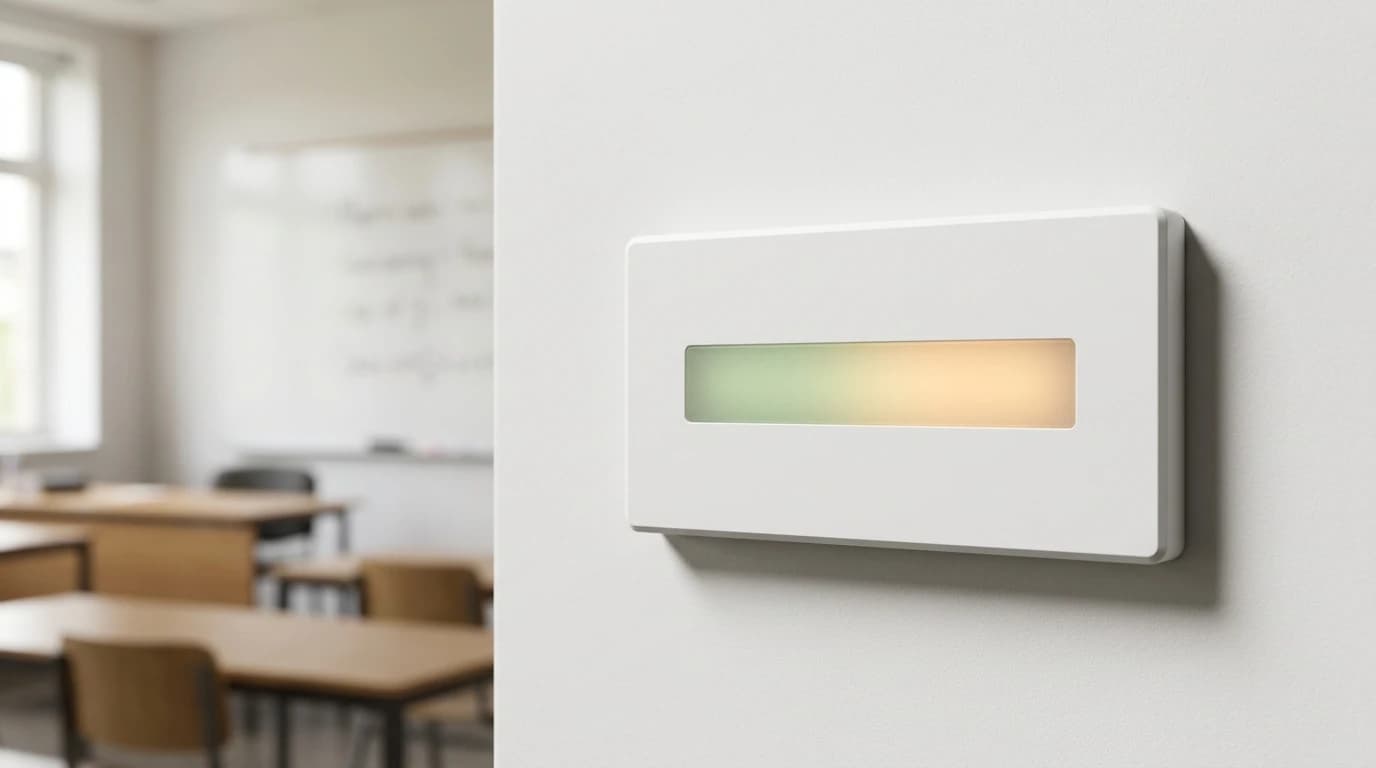
SchoolSense Sound sensor wall-mounted in an Australian classroom

The gap we’re closing

Not a noise meter. Not a behaviour-management toy.

CategoryExamplesWhat’s missing
Classroom noise toolsToo Noisy, Yacker TrackerEvidence; sensory-safe design
Industrial sound metersSoundEar, PulsarClassroom UX; multi-room deployment
Wellbeing platformsLife Skills GO, SentralEnvironmental data

SchoolSense Sound is the connective tissue — objective acoustic data, formatted as inclusion and compliance evidence.

Optimal conditions vary by activity and by learner. The product reports; teachers and inclusion staff judge.

Four pillars

How SchoolSense Sound is different.

01

Silent, continuous, ambient feedback

Activity-aware. Never an alarm.

02

NCCD-grade evidence by default

Built for the 10-week / 7-year cycle

03

Co-designed and research-backed

With Autism QLD, UQ, SPELD QLD

04

Capex-aligned with QED v5.0

35–45 dB(A) target · 0.4–0.5s RT

Architecture

Three components, one platform.

Attribute

The sensor

The web platform

Companion mobile app

FormWall- or ceiling-mounted; smoke-detector-sizedBrowser-based dashboard; three viewsOptional phone app
CapturesL_Aeq, L_A90, L_AFmax, dB(A); passive RT_60Live state, history, adjustment logs, NCCD exportsSpot checks during outdoor or off-site activity
Data handlingOn-device processing — raw audio never leavesNumeric metrics only, Australian-hostedPhone mic with clear calibration caveats
PowerUSB-C or PoE for fixed installBrowserPhone battery
Used byEveryone in the roomTeachers, inclusion staff, leadershipVisiting OTs and inclusion coaches

Instrumentation

What SchoolSense Sound measures.

Calibrated to AS/NZS 2107 reference and IEC 61672 Class 2 tolerance — a purpose-built classroom instrument optimised for education, not a research-grade Class 1 meter (those cost AUD $5,000–$15,000 and aren’t designed for multi-room deployment).

Hard rule

No raw audio leaves the device.

Acoustic processing happens on-device. Only derived numeric metrics — dB(A), timestamps, reverberation — leave the sensor. A hard rule, not a feature flag.

NCCD evidence

The evidence cycle, automated.

Adjustments and acoustic context, timestamped together. Exportable to Sentral, PLPs, and existing NCCD logs.

Sample · NCCD adjustment record

Year 4B · 24 May 2026

Adjustment planned

Front-row seating during literacy block (Student S.P., Year 4B)

Acoustic context (auto-captured)

L_Aeq

58 dB(A)

L_A90

47 dB(A)

Above 60 dB(A)

22 of 45 min

Implementation verified

Yes · 09:15–10:00 · Logged by M. Chen

QED v5.0 alignment

The standard requires the metric. Until now, no one was measuring it.

What QED v5.0 mandates

Ambient noise 35–45 dB(A); reverberation 0.4–0.5 seconds; STI ideally measured at commissioning.

What's currently happening

No way for most schools to verify the thresholds — on day one, or five years in.

What SchoolSense Sound measures

Exactly those metrics. Continuously. In every classroom — not a one-off commissioning visit.

Calibration we stand behind

AS/NZS 2107 reference. IEC 61672 Class 2 tolerance. Classroom-grade, not research-grade.

Research backing

Co-designed with the students and educators who use the spaces we measure.

Co-design partners

Autism Queensland

Lived-experience consultation; sensory-safe design review.

UQ — Wilson group

Auditory processing research; classroom acoustics evidence base.

SPELD Queensland

Specific learning differences lens; teacher-facing usability.

Students, educators, OTs and SPs

Direct co-design sessions in pilot rooms; cultural and learning diversity treated as input; a feedback channel for the device itself.

Australian classroom validation, before any clinical claim.

The product reports metrics. It doesn’t diagnose. It never replaces OT assessment.

We’re piloting with QLD schools now.

Five to ten Queensland schools, one term. Tell us about yours.